Cloud gaming is transforming the way games are developed, delivered, and played. As internet infrastructure and server technologies advance, the future of gaming is shifting from consoles and downloads to on-demand experiences streamed directly from the cloud.
But how does cloud gaming work under the hood? And more importantly, what does it mean for developers and studios?
In this article, Linea Digitech unpacks the core technology behind cloud gaming, explains the emerging GaaS (Gaming as a Service) model, and outlines what developers need to know in 2025.
☁️ What Is Cloud Gaming?
At its core, cloud gaming allows players to stream and play high-end video games on any device—without the need for powerful local hardware like gaming PCs or consoles.
Think of it like Netflix, but for games.
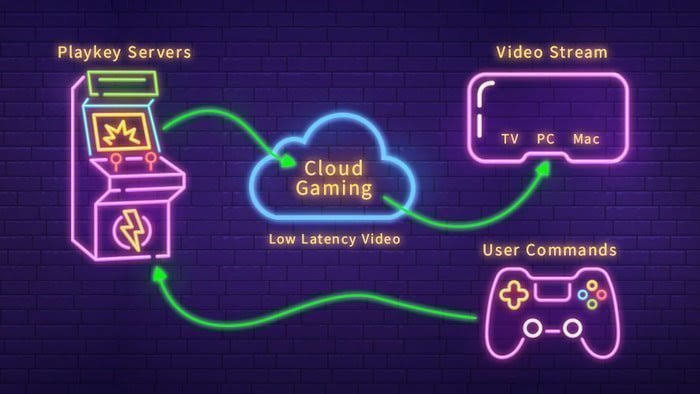
Games are hosted and rendered on powerful remote servers. The video and audio output is streamed to the player’s device, while the input (keyboard, controller, etc.) is sent back to the server in real time.
🔧 How Cloud Gaming Works: The Technical Breakdown
Understanding how cloud gaming works involves three key components:
1. Remote Rendering (Game Execution in the Cloud)
The game is installed and runs on a remote GPU-powered server, often located in a data center.
- No processing is done on the user’s device
- Supports ultra-high-end graphics and resolution
- Requires server-side optimization
2. Video Streaming (Low-Latency Delivery)
The game’s output is captured as a live video stream and sent to the user’s device using adaptive bitrate technologies.
- Similar to live video streaming
- Must maintain frame rate (60-120 FPS) and resolution (up to 4K)
- Uses protocols like WebRTC, HLS, or proprietary tech
3. Input Redirection (Real-Time Interaction)
Player inputs are transmitted upstream to the cloud server with minimal delay.
- Requires fast round-trip latency
- Typically under 100ms for smooth gameplay
- Optimized using edge computing and CDN (Content Delivery Network)
🧪 Cloud Gaming Architecture
[Player Device] ← Video/Audio Stream ← [Cloud Server] ← Game Engine
[Player Device] → Controller Input → [Cloud Server]
Cloud platforms handle rendering, storage, networking, and user authentication—leaving player devices as simple display and input terminals.
🧩 GaaS Explained – Gaming as a Service
GaaS (Gaming as a Service) refers to the subscription-based or on-demand model of delivering games via the cloud. It changes how games are:
- Monetized: Through subscriptions, microtransactions, or access passes
- Updated: Pushed server-side instantly without downloads
- Distributed: Playable across multiple devices instantly (TVs, phones, laptops)
Examples of GaaS Platforms in 2025:
- Xbox Cloud Gaming (xCloud)
- NVIDIA GeForce NOW
- PlayStation Cloud
- Amazon Luna
- Google Immersia (emerging platform in 2025)
💡 What Cloud Gaming Means for Developers
Cloud gaming isn’t just a new way to deliver games—it’s a paradigm shift in development strategy.
Here’s how developers need to adapt:
1. 🎮 Optimize for Low Latency
Cloud games must run smoothly under streaming conditions. That means:
- Prioritizing low-latency input handling
- Reducing load times
- Compressing game assets for streaming
2. ☁️ Build for Multi-Platform Streaming
Games must look and perform well on everything from a high-end TV to a budget smartphone. Developers need to:
- Test responsiveness at various resolutions
- Implement dynamic UI scaling
- Design with streaming bandwidth constraints in mind
3. 🔄 Embrace Continuous Deployment
With GaaS, games are treated like living services rather than finished products.
- Push real-time updates to the cloud
- Monitor player data and adapt gameplay accordingly
- Use A/B testing and feature flags
4. 🧱 Integrate Cloud-Native Features
Cloud infrastructure enables new features like:
- AI-powered matchmaking and NPCs
- Massive, persistent online worlds
- Real-time multiplayer with minimal lag
- Cloud-based save states and instant play
5. 💰 Monetization Through Subscriptions & Microtransactions
Developers must adapt to GaaS revenue models:
- Battle passes, in-game currencies, tiered subscriptions
- Offering exclusive cloud-only content
- Dynamic content delivery tied to player engagement
📊 Cloud Gaming vs Traditional Gaming
| Feature | Traditional Gaming | Cloud Gaming (GaaS) |
|---|---|---|
| Installation Required | ✅ | ❌ |
| Hardware Dependency | High-end device needed | Any device with a screen |
| Updates | Manual download | Instant via the cloud |
| Monetization Model | One-time purchase | Subscription / GaaS |
| Performance Scaling | Hardware-limited | Scalable via cloud servers |
| Platform Portability | Limited | Seamless cross-device play |
🔮 The Future of Cloud Gaming in 2025 and Beyond
Cloud gaming continues to rise thanks to:
- 5G and Wi-Fi 7 for ultra-low latency
- AI upscaling and rendering (DLSS, FSR, RTX Remix)
- Edge computing via global data centers
- VR/AR streaming over the cloud
Developers are no longer just building games—they’re building platform-agnostic experiences that adapt to player environments.
💼 How Linea Digitech Supports Cloud Gaming Development
At Linea Digitech, we help game studios and tech companies:
- Transition from traditional development to GaaS
- Optimize games for cloud platforms
- Integrate real-time cloud features
- Build scalable backends with cloud-native tools (AWS, Azure, GCP)
- Create stunning cross-platform experiences that are cloud-first
We’re your partner in building the next generation of cloud-native games.
✅ Final Thoughts
Understanding how cloud gaming works is essential for any developer entering the modern gaming landscape. As GaaS becomes the standard model, development priorities must shift toward:
- Low-latency streaming
- Multi-device compatibility
- Continuous deployment
- Scalable cloud infrastructure
Cloud gaming isn’t the future—it’s the now.